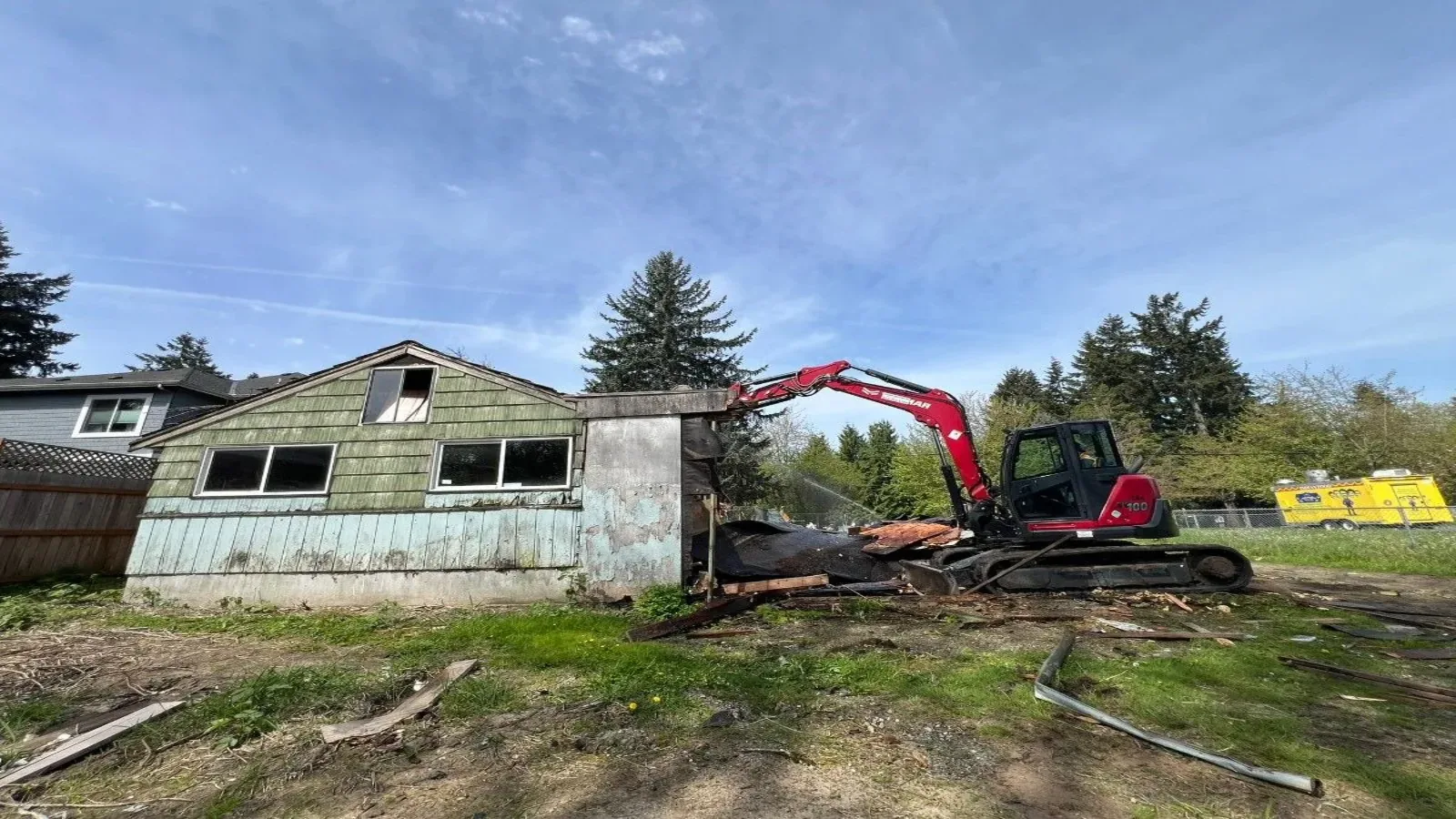
How Much Does It Cost to Demolish a House in Connecticut?
National cost guides put a whole house teardown at about $4 to $17 a square foot. Most projects in those guides land between $6,000 and $25,000, with an average near $15,800. A guide that publishes Connecticut city figures is tighter, at roughly $10,700 to $23,000 for a single family house.
Those are market numbers, not our price list. The spread is wide because the house is only part of the job. In Connecticut the number moves on the asbestos survey, the utility disconnects, the town permit and the foundation. A real house demolition price comes from a look at the site.
What do the published numbers say?
Here is what the published guides show. Read them as a starting range and nothing more.
| What is coming down | Published range |
|---|---|
| Whole house, per square foot | $4 to $17 |
| Whole house, national average | $15,800 |
| Whole house, most projects | $6,000 to $25,000 |
| 2,000 square foot house | $8,000 to $34,000 |
| 3,000 square foot house | $12,000 to $51,000 |
| Connecticut city figures, single family house | $10,700 to $23,000 |
| Connecticut city figures, one to two car garage | $2,800 to $4,600 |
A second national guide sits lower. It gives $5 to $10 a square foot and $7,500 to $15,000 for a full teardown. Guides average the whole country, so a gap like that is normal. Your house, your lot and your town set the real figure.
What drives the price of a Connecticut teardown?
The asbestos survey and any abatement. Connecticut’s environmental agency is clear on this one. Commercial, industrial, institutional and public structures must be inspected by an asbestos consultant before demolition starts. The same applies to residential structures with five or more units. Abatement over 3 linear feet or 3 square feet goes to a licensed asbestos contractor.
State rules also call for a written demolition notification to the state health commissioner. It is due at least ten days before the work starts, for the demolition of any facility. National guides put asbestos testing at $250 to $800, and a survey done for a demolition at $900 to $1,200. Removal averages $1,170 to $3,120, with interior work at $5 to $20 a square foot.
The utility disconnects. A Connecticut town cannot issue a demolition permit without written notice from all public utilities. That notice has to say the service connections were severed. The utilities set their own schedule, so this lands on the calendar more than on the invoice.
The town permit and the demolition delay. There is no state demolition permit in Connecticut. The permit comes from the building official in the town where the house sits. National guides put permit fees at $100 to $500. A town may also impose a waiting period by ordinance of up to 180 days.
Monroe uses the full 180 days. Stamford and Westport also run 180 on the statewide list, Norwalk 120, Bridgeport and Trumbull 90, and Fairfield 60. Danbury, Stratford and Newtown show no delay. The town decides which buildings the delay catches.
During a delay, state law allows no work toward demolition. That includes asbestos abatement, so the survey and the removal cannot be front loaded. We tell you what your town will ask for and line the job up around it.
The foundation and the cellar hole. State law says anyone who opens a cellar hole has to fill it to grade. The excess material, rubbish and debris come off the property. National guides put foundation removal at $1,000 to $5,000. One guide runs basement removal from $5,000 to $25,000.
The Connecticut city figures show the same jump. A house under 4,000 square feet with no basement runs about $10,700 to $13,800. The same house with a basement runs about $13,000 to $17,200. Old fieldstone foundations and thick footings add hours, and that is where concrete removal does the work.
Ledge and access. Fairfield County ground is glacial till over rock, with ledge close to the surface in places. Ledge slows the dig out and the backfill. A narrow lot limits where machines and trucks can sit. Those hours land in the estimate.
Disposal. Connecticut classifies demolition debris as bulky waste. It goes to a permitted facility and it is billed by weight. Published town transfer station schedules give a feel for the rate. One Connecticut town lists $110 a ton. Another lists $9 per 100 pounds.
Concrete, brick and asphalt fragments count as clean fill under state rules, so they can often be recycled. A tree stump is not clean fill and has to go to a permitted facility.
Is a partial teardown cheaper than a full one?
Sometimes. One national guide puts partial demolition at $1,000 to $20,000 and a full teardown at $7,500 to $15,000. A partial job costs less when you are only taking an addition, a wing or a porch. It costs more when the part that stays has to be protected and the work slows to hand tools.
What about a garage, a barn or a shed?
Small buildings carry their own numbers. National guides list a detached garage at $800 to $10,000 and a shed at $500 to $3,500. A barn runs $1,200 to $25,000. The Connecticut city figures put a one to two car garage at $2,800 to $4,600. The slab or footings under them are a separate line, covered on our page for garage, barn and shed demolition.
How long does a house teardown take?
The structure itself goes fast. One national guide says a small to medium house comes down in three to seven days. That clock starts once the permit is in hand, and it covers hauling and site cleanup. Another guide gives a wider spread, from several hours to several weeks.
The calendar is usually set by what happens before the machines show up. The survey, the disconnects and the permit run on their own clocks.
Is it cheaper to tear down or remodel?
Remodeling keeps the foundation and the shell, so it wins when the bones are sound. A teardown wins once the patching bill climbs toward the cost of building new. We put the numbers side by side in tear down and rebuild versus remodel.
Getting a real number for your house
Every figure here is a published market range, not a quote from us. Your number comes from the size of the house, the foundation under it, the lot and the town. We look at the site and put a written estimate in your hands, and the estimate is free.
Call (412) 944-9931 to get that started. You can also read how the work runs from a demolition contractor in Monroe and across Fairfield County.